Why You’ll Love this Homemade Beef Jerky
If you’ve ever priced beef jerky at the grocery store, you know that tiny bag costs about as much as a decent steak—which feels like highway robbery when you realize it’s basically just dried meat.
Making it yourself solves that problem immediately. You control everything: the thickness, the marinade intensity, how chewy or crispy you want it.
Plus, you can pronounce every ingredient going into your body, which is invigorating. The best part? Your house smells incredible during those eight slow-drying hours, like you’re running some kind of legitimate smokehouse operation from your suburban kitchen.
What Ingredients are in Homemade Beef Jerky?
The ingredient list for homemade beef jerky is invigoratingly short, which feels like a small miracle in a world where recipes often demand seventeen specialty items you’ll never use again. You need good beef, a solid marinade to give it flavor and help with preservation, and honestly that’s about it. The marinade itself is where the magic happens—a blend of salty, sweet, tangy, and aromatic ingredients that transform plain meat into something you’ll actually crave at 3 PM when the vending machine is calling your name.
Ingredients:
- 2 lbs beef (round, rump, or sirloin tip—London broil works best)
- 1/3 cup dry sherry
- 1/2 cup soy sauce
- 1/3 cup chicken stock or beef stock
- 3 tablespoons rice wine vinegar
- 1 tablespoon brown sugar
- 1 teaspoon fresh ginger root, finely diced
- 2 garlic cloves, chopped
- 1 teaspoon fresh ground black pepper
The beef selection matters more than you might think, and London broil really does edge out the competition because of how it slices. You want lean cuts with minimal fat since fat doesn’t dry well and can make your jerky go rancid faster, which is the opposite of what we’re going for here. Fresh ginger and garlic make a noticeable difference over the powdered versions—they add this bright, punchy quality that dried spices just can’t match. The dry sherry might seem fancy, but it’s usually sitting on the bottom shelf at the grocery store for like six bucks, and it adds a depth that’s hard to replicate with anything else. If you absolutely can’t find it, you could substitute with more stock and a splash of worcestershire, but the sherry really does earn its place in this lineup.
How to Make this Homemade Beef Jerky
The first step is one of those counterintuitive cooking moves that makes you wonder who figured it out in the first place—you need to freeze your 2 lbs of beef for about 2 hours until it’s almost solid. Not frozen solid like a hockey puck, just firm enough that when you slice it, you’re not wrestling with floppy meat that refuses to cooperate.
This is genuinely important because trying to cut thin, even slices from room-temperature beef is an exercise in frustration, and we’re aiming for neat 1/8-inch slices here, which is pretty thin. Once it’s firm enough, cut with the grain (not against it like you’d for tender steak), and arrange all your slices in a shallow dish.
While you’re doing that, mix your 1/3 cup dry sherry, 1/2 cup soy sauce, 1/3 cup chicken or beef stock, 3 tablespoons rice wine vinegar, 1 tablespoon brown sugar, 1 teaspoon fresh diced ginger, 2 chopped garlic cloves, and 1 teaspoon black pepper in a saucepan, bring it to a boil, then let it cool completely before pouring it over the meat.
Pop the whole thing in the fridge overnight, giving it a stir once or twice if you remember, which allows all those flavors to really sink in.
The next day, things get real. Line your oven bottom with foil because drips are inevitable and cleaning your oven is nobody’s idea of a good time. Preheat to 250°, then pat each slice of meat dry with paper towels—this step matters because you want the meat to dry, not steam.
Arrange everything in a single layer on a roasting rack, slide it into the oven, then immediately drop the temperature to 150°. This is where patience becomes your main ingredient because you’re looking at about 8 hours of drying time, though it could be anywhere from 6 to 24 hours depending on how thick your slices are and how your particular oven behaves.
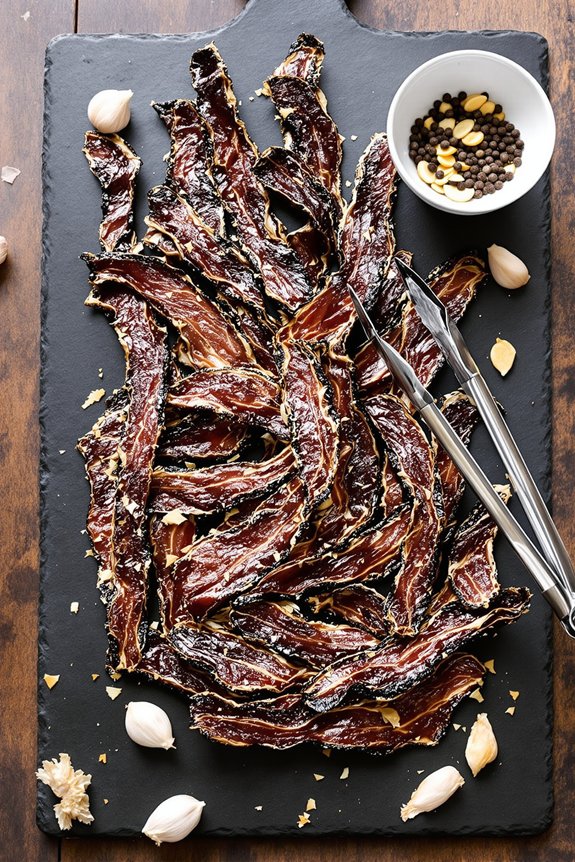
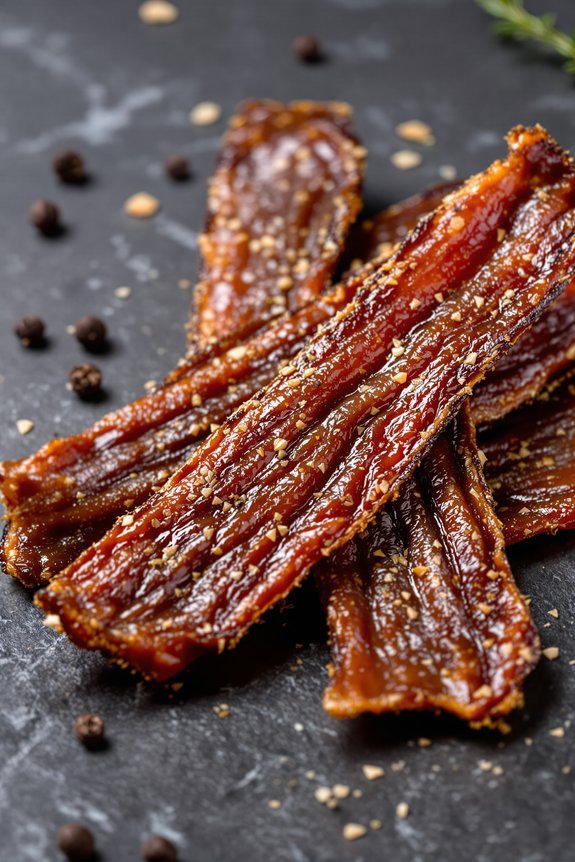
The finished jerky should be stiff but still bendable, not snapping in half like a dried-out twig, and definitely not wet or squishy. One important safety note that’s worth mentioning—meats need to dry at 145° or above to kill any microorganisms, so even though we’re dropping to 150°, we’re still in the safe zone.
If you’re looking to scale up production beyond the home kitchen, a professional deep fryer can handle larger batches of meat products for commercial operations. Store your finished jerky in an airtight container in the fridge, where it’ll keep for weeks assuming it lasts that long, which is a pretty big assumption.
Homemade Beef Jerky Substitutions and Variations
While you could absolutely follow this recipe to the letter every single time and end up with perfectly respectable jerky, there’s something to be said for tinkering around with the flavors and ingredients once you’ve got the basic technique down.
I’m talking about swapping the sherry for bourbon or whiskey, doubling up on the garlic if you’re into that sort of thing, or throwing in some cayenne pepper for heat.
You could even try different meats, like venison or turkey breast, though the drying times might need adjusting. The marinade’s your playground here.
What to Serve with Homemade Beef Jerky
Jerky’s one of those snacks that pretty much stands on its own two feet—you can shove a piece in your mouth while you’re hiking, driving, or pretending to work from home, and you’re good to go.
That said, if I’m setting out a spread, I’ll throw together some cheese cubes, crackers, maybe some pickles or olives for contrast. The salty-tangy thing plays off jerky’s savory intensity.
Beer works too, obviously. Or trail mix if you’re going full outdoorsy.
Really though, it’s perfect solo—like potato chips but with protein, which makes me feel slightly less guilty about inhaling half the batch.
Final Thoughts
Look, making beef jerky at home isn’t going to save you money—let’s just get that out of the way right now.
But that’s not really the point, is it? You’re doing this because store-bought jerky tastes like cardboard soaked in liquid smoke, and you want something better.
This recipe gives you control over every ingredient, every flavor, every chew. Sure, it takes patience—eight hours of your oven running, a whole night of marinating.
But when you pull that first piece from your container, still slightly warm and perfectly seasoned? You’ll get it. You’ll absolutely get why this matters.